The Thread Movement Journal · Issue One · 2026

The research behind the T.H.R.E.A.D. System™

A diagnostic and transformation framework that helps people and organizations examine pressure, surface recurring patterns, and redesign the conditions that shape performance, culture, talent, and impact.

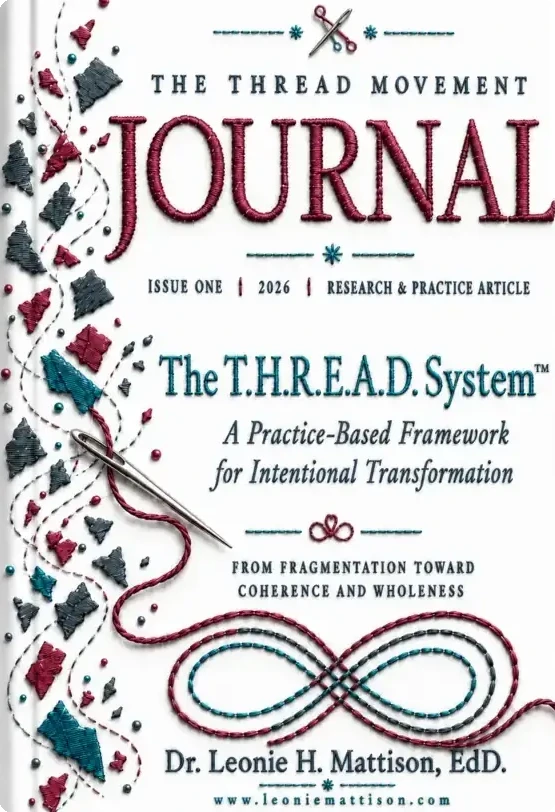
Cover of The Thread Movement Journal, Issue One, 2026
  • 6practices that form the System
  • 4movements published in Issue One
  • 36pages, research and practice
  • 82scholarly references
  • 20+years of executive practice examined

The basis for the framework

Practice, examined with rigor

Issue One presents the T.H.R.E.A.D. System™ as practice-grounded and theoretically integrated: a framework built from lived leadership practice, then tested against established scholarship.

The framework is grounded in autoethnographic practitioner inquiry, drawing on more than two decades of executive leadership practice across higher education, public systems, nonprofit, workforce development, and community transformation. Consistent with the reflective practitioner tradition, practice itself is treated as a form of knowing.

The journal is explicit about the limits of that position. The insider view enables pattern recognition that outside observation rarely reaches, and it also carries the risk of interpretive self-confirmation. The framework answers that risk with evidence testing, stakeholder mapping, observable behavior as the primary validation criterion, and disciplined facilitation standards.

It does not claim that executive practice replaces randomized study. It argues that practice, examined with scholarly rigor across diverse contexts, is a legitimate and distinctive form of evidence.

Abstract, in brief

What Issue One sets out

Context

Many organizations are trying to meet the demands of this moment with systems, habits, governance practices, and operating assumptions built for another era. Transformation cannot be reduced to activity, communication, or implementation plans alone. It requires a disciplined diagnosis of the system conditions that shape performance and behavior.

Framework

Six applied practices: Think Deeply, Harvest Wisdom, Release Patterns, Enlist Allies, Adopt Change, and Design Wholeness. The framework guides individuals and systems from symptom recognition to pattern diagnosis, aligned behavioral change, and the redesign of operating conditions.

Methodology

Autoethnographic practitioner inquiry, informed by cultural epistemology, particularly the tradition of quilting as a method of knowledge transmission among women of the African diaspora and the Caribbean. Patchwork ethnography serves as a structured reflexive method.

Practice applications

Applied across individual, team, leadership, organizational, community, and public systems contexts, including mentoring, executive coaching, leadership development, organizational consulting, and public systems transformation.

Scope and boundaries

Integrates organizational development, systems thinking, adaptive leadership, implementation science, autoethnographic inquiry, and selected depth psychological theories as nonclinical interpretive resources. Not intended for psychotherapy, clinical supervision, treatment, diagnosis, or psychometric assessment.

Contribution

An integrative practice architecture that connects diagnostic reflection, institutional learning, pattern interruption, relational infrastructure, adaptive behavior, and systems design, centering the pressure response pattern in transformation practice.

Summarized from the Issue One abstract. Read the full abstract and keywords in the PDF.

The contribution of T.H.R.E.A.D. System™ lies in the disciplined sequencing of established organizational and developmental insights into a practical, usable architecture. This framework begins at the point where most change efforts break down: the moment pressure enters a person, team, organization, or community and triggers familiar response patterns.

Central thesis, Issue One

Quilting as epistemology

A cultural way of knowing

Issue One treats quilting as more than metaphor. It draws on the tradition of quilting as a method of knowledge transmission among women of the African diaspora and the Caribbean, which shapes the framework's core language of thread, pattern, and wholeness. Each quilt-making discipline has an organizational parallel, and each parallel maps to one of the six practices.

Table 1. Quilt-making practice logic and the six T.H.R.E.A.D. practices
T.H.R.E.A.D. practiceQuilt-making disciplineOrganizational and talent development parallel
Think DeeplyStudy the fabric and the condition of the pieces.Slow down before action; examine pressure, role, history, emotion, meaning, and the system signal.
Harvest WisdomRecover the story, prior use, texture, and constraints of the material.Treat lived experience, data, stakeholder knowledge, and institutional memory as design intelligence.
Release PatternsCut away what cannot carry the design or must be reshaped.Identify protective behaviors, outdated assumptions, harmful routines, and structural contradictions that have outlived their purpose.
Enlist AlliesPiece the fragments with support, alignment, and shared pattern.Mobilize sponsors, proximate knowledge, cross-functional partners, governance, accountability, and trust.
Adopt ChangeStitch repeatedly so the pattern becomes durable.Translate insight into practiced behavior, routines, manager actions, decision rights, and learning transfer.
Design WholenessLayer, quilt, and bind the whole so it is ready to use.Align purpose, people, culture, authority, resources, metrics, reinforcement, and sustainment.

A quilt does not become whole because its pieces are beautiful. It becomes whole because the maker studies the fragments, chooses a pattern, makes precise cuts, joins each piece with care, reinforces the layers for strength, and binds the design so it can be used.

Practice analogy, Issue One

How the System works

From pressure to coherence

The System converts pressure into diagnostic intelligence. It first identifies what is happening beneath the visible challenge, then assesses the real cost of continuing the familiar response. In Issue One, its operating logic moves in four directions.

  1. Locate Inward

    Name what is happening beneath the first explanation. Think Deeply slows the system down enough to reveal the pattern that shapes behavior, decisions, and outcomes.

  2. Assess Backward

    Examine what experience has taught and what repetition is costing. Harvest Wisdom surfaces knowledge. Release Patterns interrupt scripts, defenses, rituals, and assumptions that limit development and change.

  3. Decide Outward

    Identify who must be enlisted to sustain the new response. Enlist Allies builds sponsorship, relational infrastructure, shared accountability, and developmental support.

  4. Act Forward

    Translate insight into practiced change and redesigned conditions. Adopt Change shifts mindsets, roles, behaviors, and practices. Design Wholeness reconfigures structures and operating conditions that sustain coherence and impact.

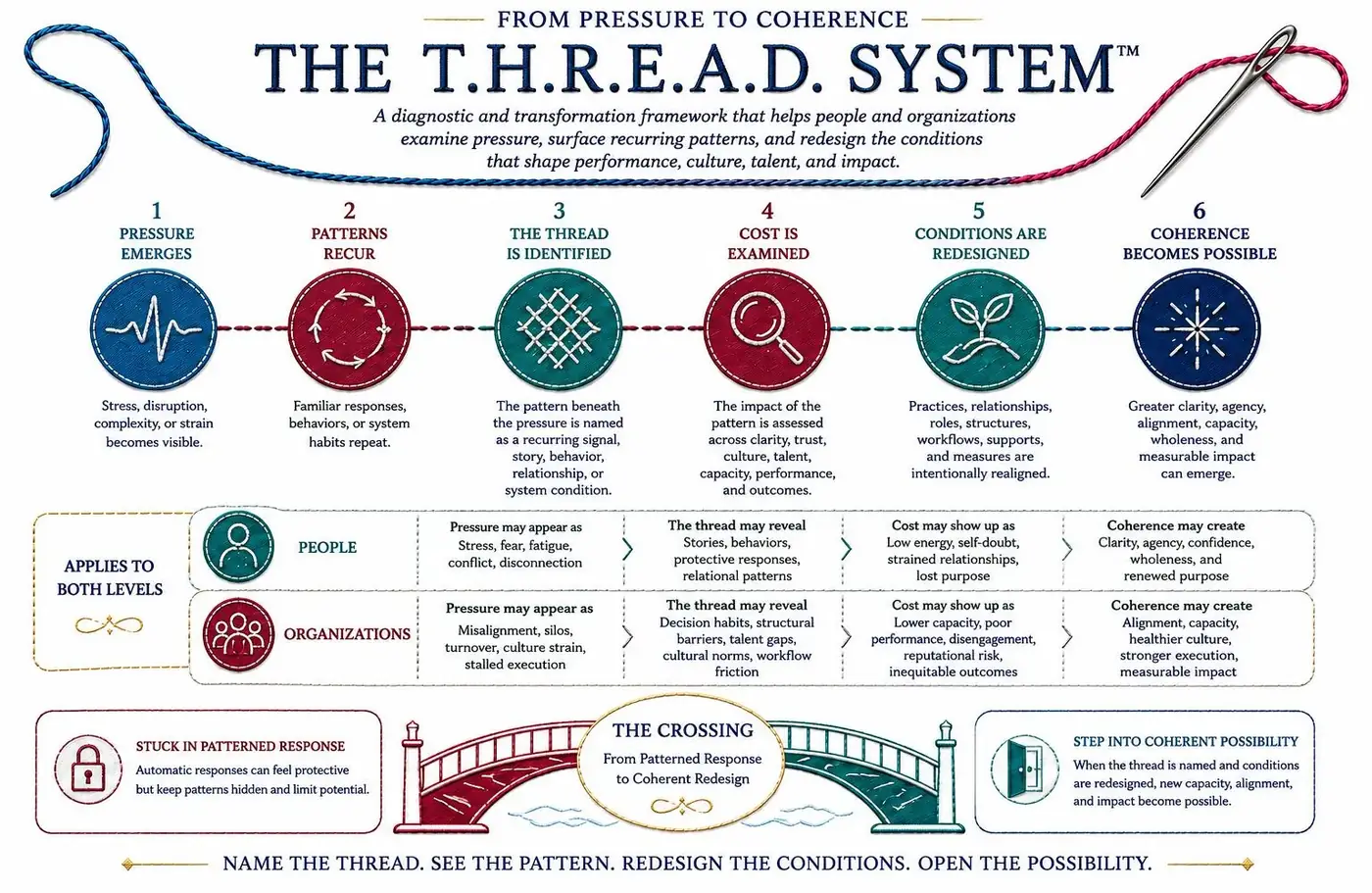
Figure 1 from Issue One, From Pressure to Coherence. Six stages run left to right: pressure emerges, patterns recur, the thread is identified, cost is examined, conditions are redesigned, and coherence becomes possible. Below, the figure shows how each stage appears for people and for organizations, and a bridge labeled The Crossing, from patterned response to coherent redesign. Its closing line reads: Name the thread. See the pattern. Redesign the conditions. Open the possibility.
Figure 1. From pressure signal to redesigned conditions. Source: The Thread Movement Journal, Issue One (2026).View the figure full size (opens in a new tab) →

See the full framework.

Issue One walks through each practice, the research behind it, and how it applies across contexts.

Research foundations

Grounded in established scholarship

The framework draws together fields that are usually studied apart. Issue One cites 82 sources; these are some of the bodies of work it builds on.

Organizational learning

How organizations detect and correct error, and why some learning stays at the surface while deeper assumptions go unexamined.

Argyris and Schön (1978); Senge (2006)

Sensemaking and judgment

How people and organizations interpret uncertain situations, and why the first explanation can feel like the only one.

Weick (1995); Kahneman (2013)

Threat rigidity

Why systems under threat tend to narrow information, centralize control, and lean on familiar responses.

Staw, Sandelands, and Dutton (1981)

Adaptive leadership

The difference between technical fixes and adaptive challenges that require people to change how they work.

Heifetz (1998); Heifetz, Grashow, and Linsky (2009)

Psychological safety

The team conditions that let people speak up, question assumptions, and learn together.

Edmondson (1999, 2018)

Implementation science

What determines whether a new practice is adopted, sustained, and integrated into routine work.

Damschroder and colleagues (2022)

Autoethnography and reflective practice

How lived experience becomes evidence when it is examined in its social and cultural context.

Ellis, Adams, and Bochner (2011); Schön (1984); Günel, Varma, and Watanabe (2020)

Depth psychology, used nonclinically

Interpretive resources for understanding protective patterns in people and groups, used as reflection rather than clinical practice.

Including Bion (1968)

Citations are listed as they appear in the Issue One reference list.

Applications

Where the System applies

Issue One describes the System as useful wherever people or institutions are under sustained pressure, repeating familiar responses, and need a structured way to see what the pattern is costing and what must be redesigned.

Self-management

Helps individuals examine their responses under pressure, so habits are not mistaken for fixed traits.

Education and training

Creates conditions where learners can examine assumptions, tolerate uncertainty, and integrate learning into practice.

See it in practice

Coaching and advising

Gives coaching, mentoring, and advising a clear architecture for slowing interpretation and choosing intentional responses.

Leadership development

Helps leaders see how their own response to pressure shapes how others interpret it.

Organizational systems

Informs design, culture, governance, strategy, and implementation when organizations repeat the patterns they want to change.

See it in practice

Youth development

Through FutureWoven™, supports young people making decisions about identity, education, work, and the future.

See it in practice

Women's transformation

Through W.A.I.T.™, helps women examine which pressures are active, what has been protected, and what the future requires.

See it in practice

Community change

Offers communities, coalitions, schools, and public agencies a shared language for examining pressure without reducing complexity.

See it in practice

Scope and boundaries

Clear about what it is, and what it is not

The T.H.R.E.A.D. System™ is educational, developmental, reflective, and organizational. Depth psychological ideas appear only as nonclinical interpretive resources. The framework is not intended for use in psychotherapy, clinical supervision, psychological treatment, trauma therapy, diagnosis, or psychometric assessment.

Issue One describes the framework as practice-informed, theoretically developing, and open to empirical examination. Its propositions remain open to study, critique, adaptation, and refinement across populations and contexts.

The journal is provided for non-commercial research, education, mentorship, leadership development, organizational learning, and instructional use, with the author's name, title, citation, and notices preserved. For permission to reproduce, adapt, teach, or license the work, email hello@thethreadmovement.com.
Read Issue One

The full article

The Thread Movement Journal, Issue One (2026). 36 pages, PDF.

Suggested citation

Mattison, L. H. (2026). The T.H.R.E.A.D. System™: A diagnostic and transformation framework that helps people and organizations examine pressure, surface recurring patterns, and redesign the conditions that shape performance, culture, talent, and impact. The Thread Movement Journal, Issue One.

Support the research

Help practice-based knowledge travel further.

The Thread Movement Journal shares the thinking behind the practices so others can examine, test, and build on it. Support helps us keep it freely available and continue the work in future issues.

  • Underwrite future issuesFund the writing, review, and design of the next issue.
  • Keep it freely availableHelp us share each issue without cost.
  • Partner on applied researchExplore how the practices work in your setting.

The Thread Movement is fiscally sponsored by the Santa Barbara Foundation.

What we document

  • Issues published and shared
  • Practitioner and partner use
  • Applied learning documented with consent
  • Questions carried into the next issue

We plan and evaluate through five elements: pressure, pattern, practice, pathway, and possibility, with coherence as the continuing aim. These are measures we intend to document, not claims of verified impact.

Bring the research into practice.

Learn the six practices through The Training, or explore how they come to life in our programs.